
Last updated: August 14, 2026 | Reading time: 10 minutes
You already have a website, social media accounts, client work, emails to answer, and approximately 47 things sitting on your to-do list. So why have a blog?
It’s a fair question. Blogging takes real time, and publishing articles just because someone said your business “needs a blog” isn’t a strategy.
A useful blog can help people find your business, understand your expertise, and trust your work before you’ve ever spoken to them. It can also become a source of content for every other channel you use. But that doesn’t mean every business needs one.
Before getting to the case for blogging, it’s worth taking the objections seriously first.
The honest objections to creating a blog
There are some genuinely good reasons not to start one.
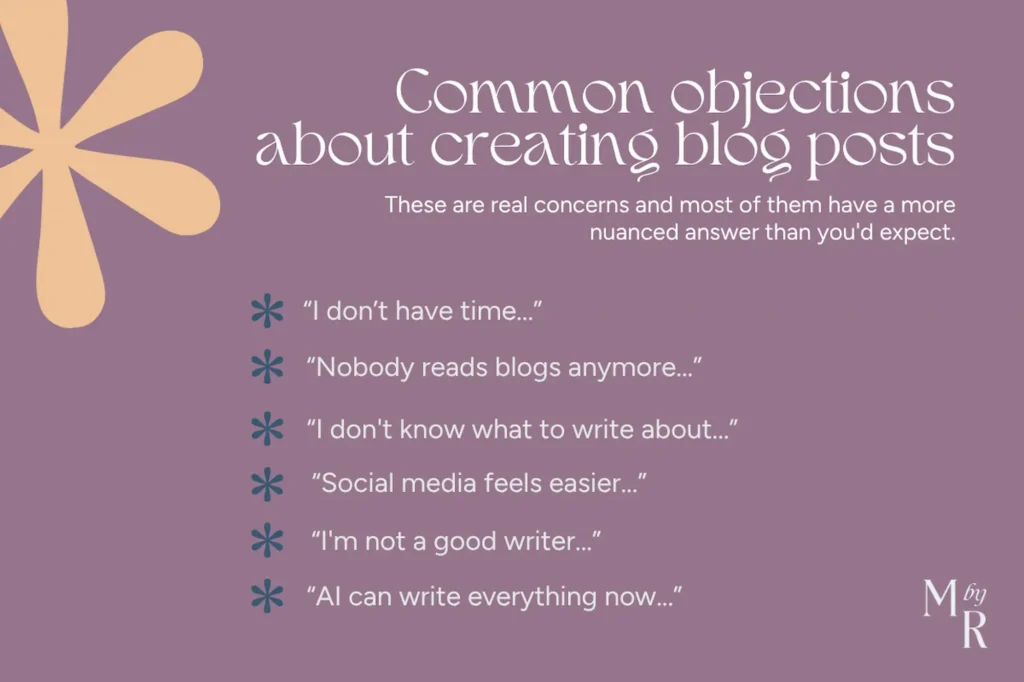
None of these are ridiculous. And the question of whether your business should have a blog is genuinely answered with “not right now” for some businesses. If your website needs a stronger foundation, your capacity is already stretched, or your audience doesn’t research you before buying, there may be better places to put your energy first.
That said, a few of these objections deserve a more nuanced answer.
“I don’t have enough time.”
This is probably the strongest argument against blogging. Running a service business already involves client work, sales, admin, and all the tasks that somehow multiply when you’re not looking.
But blogging for small businesses doesn’t have to mean publishing every week. A realistic approach might be one genuinely useful article a month, or even less if you focus on updating strong existing content. Your publishing schedule should fit the business you actually run, not some imaginary content calendar you found on LinkedIn.
One of my longest-standing clients, Pepitone Law, is a very busy lawyer that barely has time to get on calls with me, their marketing manager! But his useful expertise allows him to publish one to two legal guides on his blog a month, and they bring in the bulk of his online traffic.
“Nobody reads blogs anymore.”
If by “blog” you mean a company diary nobody has a reason to visit, then yes, that probably won’t attract much attention. But people still search for answers. They research problems, compare options, look up costs, and try to understand complicated topics before deciding what to do next.
A potential client may never think “I should go read this company’s blog.” They’ll search a question on Google, find your article, and discover your business in the process. Whether people still read blogs in 2026 is not so much the question as much as how they are reading blogs in 2026, considering how much AI and search have changed the picture.
“I don’t know what to write about.”
You probably know more than you think. The questions clients ask you repeatedly are content ideas. So are the objections you hear during sales calls, the mistakes you keep correcting, and the things you wish every new client understood before hiring you.
A plumber could explain why a drain keeps blocking. A brand designer could explain what actually goes into a rebrand. A consultant could write about what clients should prepare before their first strategy session. You don’t need to invent topics from thin air. Start with the problems you already solve.

“I’m not a good writer.”
Being good at your profession and being good at writing are two different skills. You can dictate ideas, work from interview-style questions, or collaborate with a writer to help organize a rough draft. The important part is that the expertise comes from somewhere real. The writing is just the delivery mechanism.
So don’t be afraid of putting your thoughts and expertise out there. At the end of the day, authenticity matters.
“AI can write everything now.”
AI has made producing generic content much easier. That’s exactly why generic content is becoming less useful as a differentiator. Your clients don’t need another article that says “five tips for better marketing.” They need your experience, your examples, your judgment, and your understanding of the situations they actually face. Your professional expertise is still the interesting part.
For a fuller look at how AI is changing content discoverability, our article on AI optimization is worth reading.
“Social media feels easier.”
Honestly, it often is. It’s faster, more conversational, and usually more immediately rewarding. But social media content lives inside someone else’s platform. Your reach depends on algorithms and platform behavior you don’t control.
A blog gives your ideas a more permanent home on your own website. And in a well-built content system, they work together rather than compete.
The benefits of blogging for business go beyond SEO
Now the more useful question: what can a blog actually do for your business?
The benefits of blogging for business are easier to see when you stop treating each article as an isolated piece of content.
One well-written article can:
- Help people find you through search and AI tools
- Let potential clients experience your expertise before they ever reach out
- Show how you think and what you believe about your industry
- Answer questions and objections that come up before someone hires you
- Feed your social media with multiple shorter posts
- Give your newsletter something genuinely useful to share
- Strengthen your website through internal links between service pages and content
- Keep working for months or years after you publish it
Those are real business blog benefits, particularly for service businesses where clients need to build confidence before making a decision. And ironically, those are the same businesses that often feel like they don’t have time to blog.

Why does my business need a blog if I already have a website?
Your website tells people what you offer. So, why have a blog anyway? Because a blog can explain why it matters, who it’s for, how it works, and what people should know before they buy.
Those are different jobs.
Imagine someone lands on your service page and sees that you offer business coaching. They might be interested but still have questions: “Do I actually need a coach?” “What should I expect?” “How do I know if this is the right time?” A useful article can answer those questions before the person ever fills out your contact form.
This is the heart behind content marketing for service businesses. When clients research before buying, your content can be the thing that tips the decision in your direction.
Want more insights like this?
I send out a monthly newsletter where I unpack everything from SEO-first strategy to real client lessons and the behind-the-scenes of building a values-led digital business. If you’re into honest takes on what makes websites actually work (not just look good) you’ll probably want in.
Your blog can feed everything else you create
One of the easiest ways to make blogging feel more worthwhile is to stop treating a blog post as a finished product. Think of it as source material.
One article could become three LinkedIn posts, an Instagram carousel, a newsletter edition, talking points for a sales call, or a set of FAQs for a service page. There’s so much untapped potential behind a single blog post, and it’s definitely worth it to maximize it.
And if you already send a newsletter, your blog and email list can work together rather than compete for your attention.
For more on how content works across multiple channels at once, our article about omnipresence SEO explains the approach.
When blogging probably isn’t the right investment
Is blogging worth it for every business? No.
Marketing isn’t a one-size-fits-all thing. What works well for one business isn’t automatically right for another. Blogging is no different.
If your website doesn’t clearly explain what you do, fix that first. If your service pages are weak, your contact process is confusing, or visitors can’t figure out how to work with you, more articles won’t solve the underlying problem.
Blogging may also not make sense if your capacity is genuinely maxed out and nobody can realistically maintain it, you need faster results and long-term content isn’t the right fit, or you’d benefit more from fixing your website foundation before adding more content to it.
There’s no shame in choosing a different channel. A newsletter might work better for your audience. Referrals might already be your strongest acquisition path. Or your website might simply need some structural attention first. A blog strategy is a choice, not an obligation.

How to decide if blogging is worth it for your business
If you’re still asking why have a blog specifically for your business, five questions worth sitting with:
- Do your ideal clients search for problems you can help solve?
- Do you have expertise that would be useful before someone hires you?
- Can you create content without consistently sacrificing client work?
- Could one article support other parts of your marketing?
- Are you willing to think about content as a long-term asset?
If most of your answers are yes, blogging could be a worthwhile part of your marketing. If most are not, that’s useful too.
For a realistic sense of how long results take, our SEO timeline guide is worth reading before you commit. And if you’re weighing the broader value of organic search for your business, our blog post “Is SEO worth it in 2026“ looks at the question directly.
Frequently asked questions about blogging for businesses
A business blog gives you a place to answer customer questions, demonstrate expertise, support search visibility, and create source material that feeds your social media, newsletter, and other marketing channels.
People may not think of themselves as “reading blogs,” but they still search for information constantly. What matters is whether your potential clients are searching for the questions and problems your content can answer.
Absolutely. A sustainable publishing schedule is more valuable than one that burns you out in three months. Monthly publishing, seasonal content, and updating existing articles are all valid approaches.
There’s no universal timeline. Results depend on the topic, competition, website strength, search demand, content quality, and how consistently you maintain it. Most businesses see meaningful traction after several months of consistent effort.
Your core topics should connect to what you sell, but covering the questions, decisions, and misconceptions surrounding those services gives potential clients more useful ways to discover your expertise.
They’re better thought of as complementary rather than interchangeable. Your blog provides the deeper resource, while social media helps distribute it and start conversations around it.
A blog should earn its place in your marketing

A blog should earn its place in your marketing. Not because every business is supposed to have one, and not because publishing 1,000 words every Tuesday magically makes Google love you.
It earns its place when it solves a real problem. When your potential clients have questions you can answer. When your expertise is hard to demonstrate through a service page alone. When you need better search visibility, stronger sales support, or a more reliable source of content for your newsletter and social channels.
Without a clear purpose and a realistic publishing process, a blog adds stress rather than results. A calm, intentional plan will almost always outperform publishing for the sake of it.
If you’re not sure whether a blog is the right move for your business right now, that’s a conversation worth having. Marketing by Rocio works with service-based businesses to figure out what actually fits their marketing and build from what’s already there rather than piling on more.
Reach out to us and let’s talk!