Last updated: August 31, 2026 | Reading time: 12 minutes
You’re staring at a marketing to-do list that feels endless: Instagram, Google Ads, SEO, email, networking, referrals, blogging, and maybe even LinkedIn, because apparently you need to be everywhere now.
So where does SEO vs other marketing channels actually land? For many small businesses, SEO is one of the strongest long-term channels because it helps you show up when people are actively searching for the problem you solve. But that doesn’t make it the automatic winner.
Knowing where your business actually stands matters way more than trying to cover every channel. What actually matters is figuring out what your business needs right now, not chasing every channel at once.
Why SEO often deserves a place in your marketing mix
SEO earns its spot in your marketing mix for two specific reasons, and both of them come down to timing. Get these right, and the rest of your marketing has an easier job to do.
It meets people who are already looking
With SEO, your customer usually starts the conversation, not you.
Someone searches “queer therapist near me,” “website designer for therapists,” or “best accountant for freelancers,” and they already have a problem they want solved. Your job is to make it easy for them to find you.
That’s one of the biggest advantages in SEO vs other marketing channels: you’re building visibility around existing demand instead of always trying to create demand from scratch.
It keeps working long after you hit publish
SEO can also compound. A useful service page or blog post can keep attracting relevant visitors long after publication, while other channels often require constant activity or spending just to maintain the same level of exposure.
That doesn’t mean every page ranks forever. Search results change, competitors improve their sites, and Google keeps updating how it evaluates content. Google also notes that some SEO changes can show up within hours, while others take months.
So SEO is best thought of as an asset you build and maintain, not a switch you flip once.
SEO vs social media: reach versus search intent
People often lump these two together, but they solve different problems. Knowing which one to lean on, and when, can save you a lot of wasted effort.
Where SEO wins
SEO is strongest when someone already has a question and is actively looking for an answer, provider, product, or service. Someone searching “queer therapist near me” already knows what they need. Your job is just to be findable when they look.
Where social media wins
Social media is excellent for staying visible, showing personality, sharing opinions, and giving people a reason to remember you. It builds familiarity before someone even has a need yet, and it can help distribute content that people later discover through search.
Which one fits your business
If your audience already searches for what you offer, like plumbers, therapists, or accountants, SEO deserves priority. If you’re building a personal brand or a community-driven audience, like a coach or a creative business, social media might carry more weight early on. Most service businesses benefit from both: search to capture demand, social to build familiarity around your name before someone’s ready to reach out.
SEO vs paid ads: patience versus speed
This one usually comes down to a single question: do you need results now, or can you afford to build something that lasts?
Where SEO wins
SEO earns organic visibility for relevant searches over time, without paying for every click. Once a page ranks well, it can keep working for months or years with minimal upkeep.
A good SEO strategy demands time and a whole lot of patience.
Where paid ads win
Paid ads put your business in front of potential customers quickly. That’s useful when you’re launching an offer, testing new messaging, entering a new market, or need leads sooner rather than later.
Google Ads also lets you compare paid and organic performance side by side, which can help you spot valuable search terms either channel might be missing.
Which one fits your business
If you need leads this month, paid ads make sense while your SEO builds momentum in the background. Our guide to SEO vs paid ads notes that realistic SEO traction often takes three to six months, depending on competition and website strength.
If you have some budget and can wait that out, running both together tends to outperform either one alone.

SEO vs referrals: trust versus control
Referrals feel like the gold standard, but they run on someone else’s schedule. Understanding that trade-off helps you decide how much to lean on them.
Where SEO wins
SEO gives you control over the questions and services you want to be found for.
You’re not waiting on anyone else to mention your name, and a strong search strategy reduces how dependent you are on a handful of referral sources.
Where referrals win
A referral arrives with borrowed trust already built in. Someone your prospect already trusts has effectively said, “you should talk to this person,” and that’s hard to replicate.
The downside is predictability. You can’t control when clients refer people, how often, or whether it’s the right kind of client.
Which one fits your business
If your business already runs on a steady referral network, that trust is worth protecting and nurturing. But if referrals have gone quiet, or you want a more predictable pipeline, SEO fills the gap by working in the background regardless of who’s talking about you this month. Most businesses do best treating referrals and SEO as two separate pipelines rather than picking one.
Want more insights like this?
I send out a monthly newsletter where I unpack everything from SEO-first strategy to real client lessons and the behind-the-scenes of building a values-led digital business. If you’re into honest takes on what makes websites actually work (not just look good) you’ll probably want in.
SEO vs networking: relationships versus discoverability
Both channels can grow your business, but they reach completely different people, which matters more than most business owners realize.
Where SEO wins
SEO reaches people who were never going to be at the same event, coworking space, or meetup as you. Someone can discover your business without ever meeting you, following you, or hearing your name beforehand.
Where networking wins
Networking is built around relationships, which is quite similar to referrals. It can introduce you to collaborators, referral partners, journalists, and prospects who might remember your name six months from now, long after a single conversation.
Which one fits your business
If your work depends heavily on personal relationships and word of mouth, like consulting or high-touch services, networking is probably already doing real work for you. But if you want to reach people outside your existing circles, SEO helps you bridge that gap. The two aren’t competing for the same audience, so there’s rarely a reason to choose only one.
SEO vs content marketing: they overlap more than people think
This comparison trips people up because it’s not really a comparison. The two work better as partners than competitors.
Where SEO wins
SEO helps content become easier to discover through search. Without it, even great content can sit unseen, waiting for the right reader who never finds it.
Where content marketing wins
Content marketing is the practice of creating useful material, like blog posts, guides, videos, or emails, that attracts, educates, and builds trust with your audience over time. It’s less about promoting your business directly and more about being genuinely helpful, so people come to see you as someone worth listening to.
A thoughtful blog post can do a lot at once. It can answer a prospect’s question, demonstrate your expertise, strengthen internal links, and support your service pages, all in a single piece.
Which one fits your business
These aren’t really competing priorities. Content gives you something useful to say, and SEO helps more people find it. If you already publish content but see little traffic, SEO is likely the missing piece. If your site is optimized but thin on actual content, that’s where to focus next.
Google recommends creating helpful, people-first content and considering the language people actually use when searching, which is really where both practices meet.

How long does SEO take?
The annoying answer is: it depends. But in terms of a general timeline, SEO takes longer than a paid campaign that starts delivering traffic on day one.
Google says some changes can show up in search results within hours, while others take several months, and recommends giving changes a few weeks before judging their effects.
With that in mind, give yourself enough runway to measure trends instead of panicking over individual ranking changes. Look at impressions, clicks, rankings, qualified traffic, inquiries, and conversions together, not any single number in isolation.
And remember that traffic isn’t the whole goal. Ten highly relevant visitors can be worth more than 1,000 people who have no reason to hire you. Our SEO timeline guide breaks down what typically happens during the early stages of a campaign in more detail.
A simple marketing channel comparison
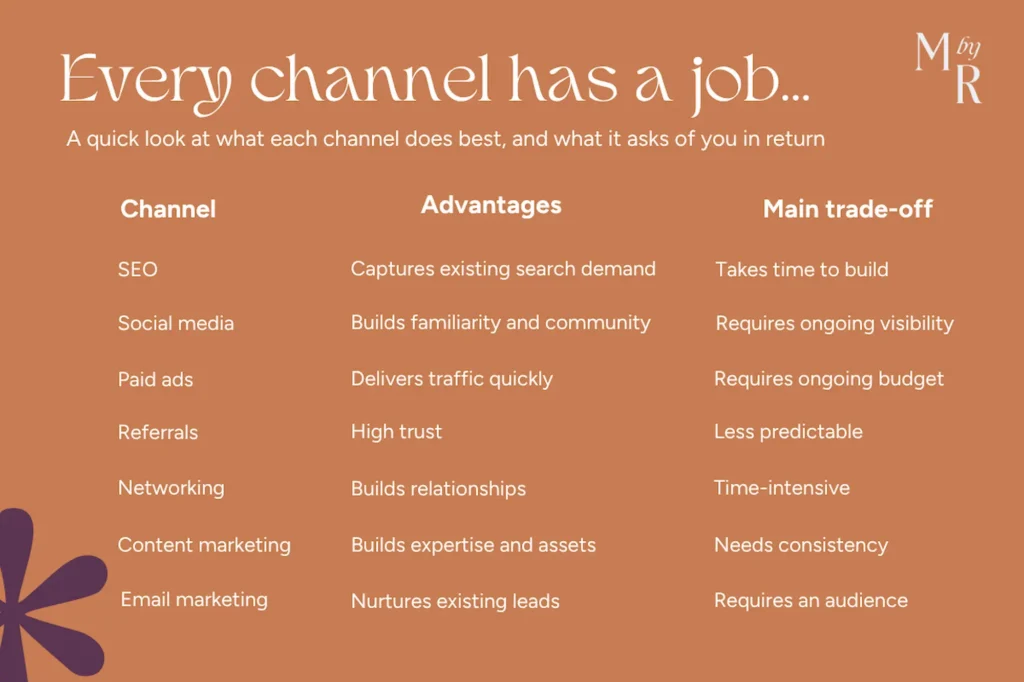
A useful marketing channel comparison starts with what each channel is actually good at.
For many service businesses, SEO belongs near the foundation because your website becomes more useful and discoverable the longer it’s maintained.
But the best marketing channel for a small business depends entirely on your actual situation. It’s not a one-size-fits-all kind of thing. A wedding photographer with a strong referral network may not need the same mix as a new local plumber. Meanwhile, a consultant with a large LinkedIn audience has different opportunities than a therapist starting from zero.
The best marketing channel for a small business is usually the one that matches how your customers already discover, evaluate, and choose a business like yours.
Choosing the right marketing channel for your business is more nuanced than you might expect. The best option is the one that matches how your customers already discover, evaluate, and choose a business like yours. On top of that, you have to weigh the trade-offs of each channel: how much time you have, how much budget you can commit, how much control you want, and how sustainable the results need to be.
For a deeper look at choosing between organic search and advertising, read our SEO vs paid ads guide for small businesses where we go further into the specifics.

Frequently asked questions about SEO vs other marketing channels
Yes. A new business can start building search visibility from day one, though newer websites often need more time and authority before competing for harder keywords.
That depends on how customers find you. A business serving a specific geographic area will usually benefit from strong local SEO alongside broader search optimization.
No. Blogs can be useful, but SEO also includes service pages, location pages, technical improvements, internal linking, structured data, and other parts of your website.
Yes, but the strategy may need to be more specific. Targeting narrower search terms, stronger service pages, and underserved topics can create opportunities broader keywords don’t.
It can be. People often search online before calling, visiting, booking, or asking someone for a recommendation, so search visibility can support offline buying journeys too.
Track qualified inquiries, booked calls, sales, important search queries, conversions, and the pages contributing to those outcomes. Traffic alone doesn’t tell you whether your marketing is actually working.
Absolutely. Many foundational tasks can be handled in-house, especially when your website is small. The challenge is usually finding the right priorities and maintaining them consistently.
Add one when you have a clear reason for doing so. A new channel should support a specific business goal, audience behavior, or weakness in your current marketing rather than just giving you another platform to maintain.
So, where does SEO fit?

After all those comparisons, the bigger lesson from SEO vs other marketing channels is that your marketing works better when each channel has a job.
SEO can help you capture people already searching for solutions. Social media can help people get familiar with your brand. Referrals can transfer trust. Networking can create relationships. Paid advertising can accelerate visibility. Content can give all of these channels something useful to distribute.
That’s why a smart marketing channel comparison should start with your customer’s behavior, not whatever channel happens to be trending this month. You don’t need to be everywhere. You need to be findable in the places that matter.
And yes, figuring that out can feel overwhelming, especially when every channel comes with its own vocabulary, dashboard, and suspiciously confident promise.
Marketing by Rocio takes a more calculated and calmer approach. We look at your business, your audience, your existing visibility, and where your biggest opportunities actually are, then build an SEO-first strategy that fits the bigger picture.
Explore our services to see what that could look like for your business. Reach out to us today!