Last updated: October 30, 2026 | Reading time: 10 minutes
If you run a small business, you’ve probably felt the quiet pressure to go viral.
Someone in your industry posts a Reel that racks up a million views, and suddenly it feels like that’s what everyone else is doing and you’re falling behind. So you start brainstorming ways to break the internet, and the more ideas you chase, the heavier the pressure feels.
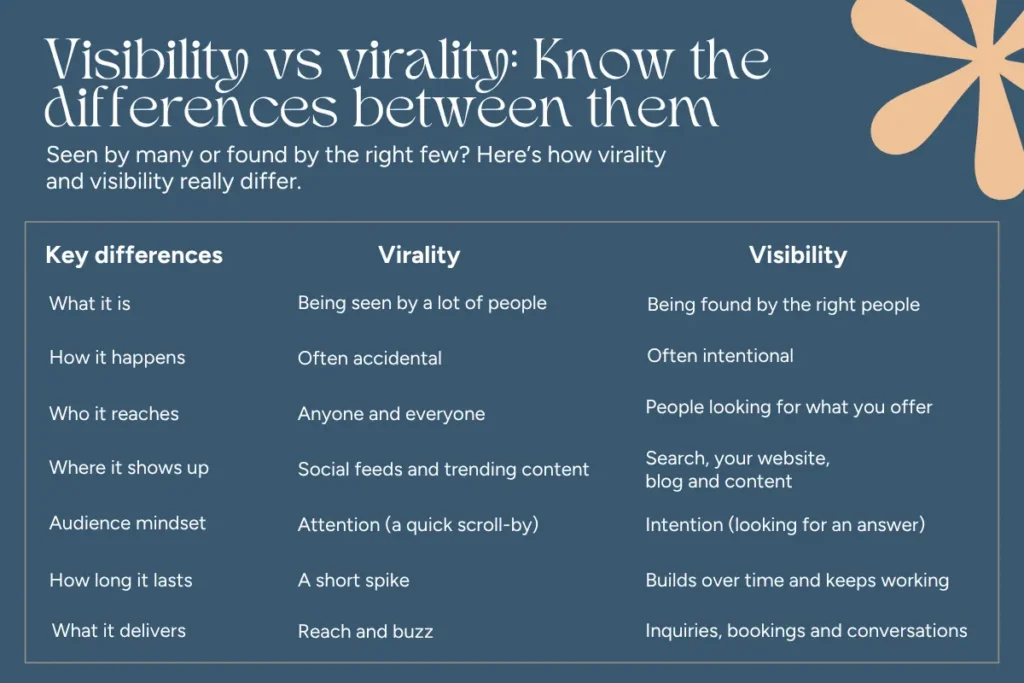
But virality and visibility are not the same thing. They sound alike, and common marketing advice often lumps them together, but they do very different jobs.
Here’s how Marketing by Rocio sees it: Virality is being seen by a lot of people. Visibility is being found by the right people.
What is virality?
Virality is when a piece of content spreads fast and wide, usually far beyond your own audience. A post takes off, gets shared, and thousands (or millions) of strangers see it in a short window.
I want to be fair to it, because going viral in marketing can be genuinely brilliant. It can be exciting and totally profitable. For some people it has been career-changing. But there’s a catch that we should discuss: virality is often accidental.
You can make a great video, post it at the perfect time, and hear crickets. You can toss up something casual and watch it explode. Even the experts can’t reliably predict it.
That makes it a pretty shaky thing to build a business on.

What is visibility?
Visibility is being easy to find for the people who are looking for what you do. It’s about showing up in the right place, at the right moment, for the right person.
Where virality is often accidental, visibility is often intentional. You build it on purpose, with a website that answers real questions, content that matches what people are searching for, and a presence people can trust when they land on it.
To know more about what visibility means for small business owners today, read our article about What Is Visibility? and get a more detailed explanation of what it means for your business.
Let me make it real with a few examples:
- A queer therapist doesn’t need a million followers. What helps their practice far more is being easy to find for people who are searching for support and want someone they can trust.
- A pet sitter doesn’t need a viral Reel. A Reel might be fun, but what fills their calendar is local pet owners finding their well-made, search engine-optimized website when they search for care.
- A consultant doesn’t need internet fame. What matters is being found by decision-makers who already understand the value of their work and are looking for that expertise.
None of them need to be seen by everyone. What they need is to be found by the right people, at the moment those people are looking for exactly what they offer. A big audience isn’t a bad thing. It just only helps when it’s the right one.

Why so many business owners confuse the two
Big numbers in your stats make it easy to confuse the two. A post with 500,000 views looks like a win, and a post with 40 views looks like a flop, even if those 40 people were exactly your dream clients.

A lot of marketing advice nudges us to think this way too. It tends to prioritise growth over alignment, so “get more eyeballs” becomes the goal, and nobody stops to ask whether those eyeballs belong to anyone who could ever work with you.
This is where it helps to be picky about which numbers you care about. Followers and views are easy to see, but they’re not always the ones that matter.
Read more about What KPIs Matter for SEO? and why not all numbers matter for your business.
There are a few pairs that often get blurred together:
- Reach vs relevance: Reach is how many people see you. Relevance is whether those people could actually become your clients, customers or collaborators. A smaller reach that’s highly relevant can be worth more than a huge one that isn’t.
- Popularity vs discoverability: Popularity is being known by lots of people. Discoverability is being easy to find when someone needs you. You can be well known and still hard to find at the moment it counts.
- Attention vs intention: Attention is a quick glance as someone scrolls past. Intention is someone actively looking for what you offer. Attention can lead to intention, but it doesn’t always.
Once you see those differences, the idea that a bigger audience automatically means better results starts to wobble. Size still matters. It just matters less than fit.

Why social media rewards virality and search engines reward discoverability
Social media platforms are built to keep people scrolling. So they tend to reward whatever grabs attention quickly: spectacle, trends, hot takes, the thing everyone is reacting to right now.
That’s not a flaw, it’s just how social media is designed. While it can be a wonderful place to build community and connection, the content that gets pushed furthest isn’t always the content that serves your ideal client best.
This is where omnipresence SEO comes in. It’s about being findable in the places your people are already looking. Search is a big part of that, and it works differently to social media. Someone types a question or a need into Google because they’re ready to find an answer. They arrive with intent. If your page answers it well, you’ve met a person at exactly the moment they were looking.
That’s the heart of digital visibility. Social media often delivers attention, but search delivers people who came on purpose.
And for queer business owners, being easy to find by the community you want to serve is a big part of queer-owned business SEO.
Want more insights like this?
I send out a monthly newsletter where I unpack everything from SEO-first strategy to real client lessons and the behind-the-scenes of building a values-led digital business. If you’re into honest takes on what makes websites actually work (not just look good) you’ll probably want in.
Why visibility compounds while virality fades
A viral post usually has a short life. There’s a spike, a rush of notifications, and then things settle back down. Plenty of people end up with a pile of new followers who never book, buy or inquire.
Visibility behaves differently. A well-built page, a helpful article or a clear service offering keeps working long after you’ve published it. Someone finds you this week, someone else finds you next month, and your reputation builds on itself. That’s what I mean by compounding.
This is the quiet superpower of having a blog. Something you write once can keep bringing the right people to you for years. If you’ve ever wondered whether it’s worth the effort, here’s why a blog is worth having in the first place.
And if you’re wondering how long it takes, I break it down in my post on the SEO timeline, and whether the effort pays off in Is SEO Worth It in 2026?
I won’t pretend it’s fast, though slow and steady has a real advantage: it’s sustainable. It doesn’t depend on you performing, or on an algorithm having a good day.

When virality can actually be useful
Virality isn’t a villain. If it happens, and you’ve got somewhere for people to land, it can open real doors.
The key is having a foundation. If a post takes off and your website is thin, your services are unclear, or nobody can tell what you actually do, all that attention has nowhere to go. It’s like a crowd turning up to a shop with the lights off.
So if virality finds you, wonderful. Just don’t build your whole plan around hoping it does.
It’s a bit like the difference between marketing tactics and marketing strategy. A viral post can be a great tactic, but it works best as part of a bigger plan. I dig into that deeper in my piece on the difference between marketing tactics and marketing strategy.
Frequently asked questions about virality vs visibility
No. Plenty of service providers, consultants and creatives grow steadily without ever having a viral moment. What you need is to be found by the people who are looking for what you offer. Audience growth that’s aligned beats audience growth that’s just big.
Focus on being discoverable. Build a website that clearly explains what you do, publish helpful content that answers the questions your ideal clients are asking, and set up your pages so search engines can understand them. Being found online mostly comes down to showing up consistently where your people are already looking.
It can be, but only if there’s a foundation to catch the attention. Virality brings a lot of eyes quickly, which helps when people have somewhere clear to go next. Without that, the attention tends to fade without turning into clients.
Start with clarity. Get specific about who you want to serve and what they search for, then create pages and content that match. Keep your website easy to navigate, and be patient, because discoverability builds over time.
Aim for relevance over reach. Speak directly to the people you want to work with, share things that are genuinely useful to them, and make it easy to take the next step. A smaller audience that fits can lead to far more enquiries than a large one that doesn’t.
Why I’d choose targeted visibility: it’s my philosophy

So, which one would I pick? Honestly, it’s not a straight either/or, and I don’t think it needs to be.
Virality is great when it happens. A big, enthusiastic audience can do wonderful things for a business, and there’s nothing wrong with welcoming it.
But the best case scenario isn’t just being seen by lots of people. It’s being seen by lots of the right people: the ones who actually want what you offer, finding you when they need it. That’s targeted visibility, and it’s what I’d aim for first.
If virality shows up on top of that, brilliant. Think of it as a bonus rather than the plan.
Here’s how it tends to play out. Virality can bring you a moment of attention. Visibility, when it’s aimed at the right people, brings opportunities: the enquiries, bookings and conversations you actually want. Targeted visibility lets you be yourself, speak to your people, and be found by them, without having to perform for strangers.
Marketing by Rocio helps businesses grow their visibility online, especially businesses that speak to a specific audience. We’ve worked with queer-owned small businesses, where being found by the right people matters most.
If you’d like that kind of visibility for your own business, reach out to us and let’s talk about what we can do to help you level up.