Last updated: April 30, 2026 | Reading time: 16 minutes
You’ve posted consistently for weeks. Reels, carousels, trending audio, captions you rewrote three times. And you’re still refreshing your inbox like it might magically change its mind.
The worst part? While you were perfecting that caption, someone typed exactly what you do into Google and hired the first result they found. Ouch!
That gap is exactly what SEO vs. social media for small businesses is really about. So which one looks better on a strategy deck and puts clients in your calendar? That’s where this guide comes in.
The difference no one explains: rented vs. owned
Social media feels productive. You post, people react, something moves. Even if it’s just a few likes and a comment from your cousin who says “love this!!” every single time.
But what many forget (or are completely unaware of) is that it’s a rented space. The algorithm decides who sees your work. Your content disappears within 24 to 48 hours, and nothing compounds. You can spend three hours on a reel that gets 400 views and contributes exactly zero to your business a month from now.
SEO works differently. Your website is yours, and your content stays live. Unlike a post that disappears into the feed, a well-optimized page keeps earning traffic weeks, months, even years after you publish it.
That’s the real tension inside SEO vs. social media marketing: one creates momentum you don’t own, and the other builds assets that keep working without you.
If you’ve been wondering whether search is still worth the effort in a world of AI and short-form video, this breakdown on whether SEO is worth it in 2026 gives you a grounded, honest answer.
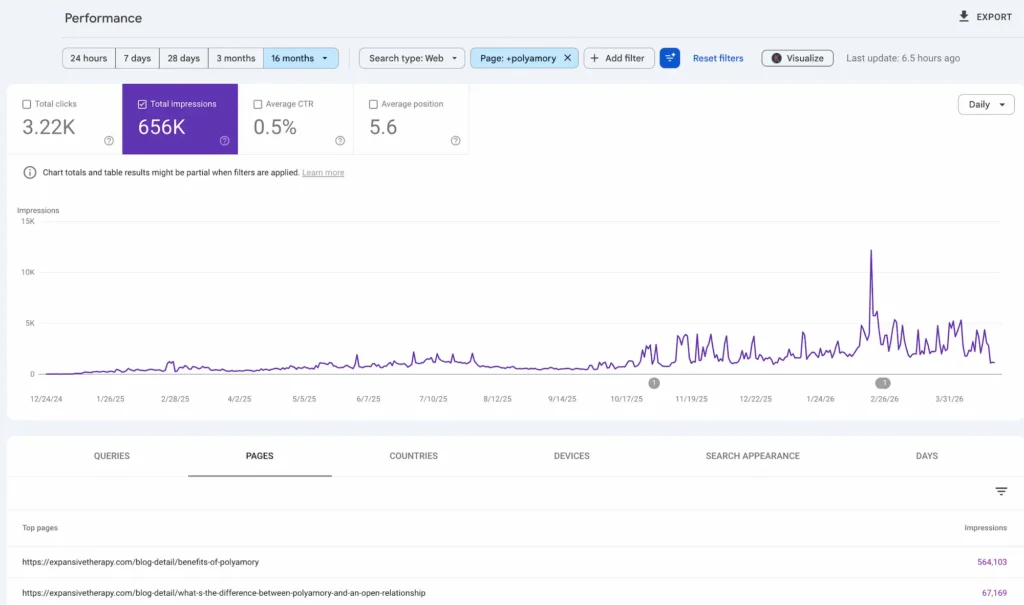
Caption: I’ve been working with Expansive Therapy for about a year and a half now, and our collaborative efforts in SEO have brought them to the top of page 1 of Google’s results page as of Q2 2026. For example, just two blogs based on the topic of polyamory have skyrocketed in visibility since we began our collaboration. To see the full context of our work together, take a look at our initial project that started with an SEO audit, and our later SEO-focused website expansion project.
Time works differently in each channel
Social media is immediate. You can post today and get attention today, which is exactly why it feels so productive. There’s dopamine in that feedback loop. And everyone loves that feeling of a rush, but that loop resets constantly. Miss a week and your reach drops. Take a real break, and you’re basically starting over from scratch.
SEO is slower by nature. You publish something optimized and then nothing happens. For a while. Then it starts showing up in search results. Then it climbs, and keeps showing up month after month without you doing anything new.
That’s the core difference when thinking about a long-term marketing strategy for SEO vs social media. Social media creates spikes, but SEO creates compounding growth. A spike feels exciting, that’s for sure, but compounding growth builds a business.
But take a breath before you start throwing your all into a huge SEO strategy. It’s worth understanding that SEO results don’t typically show up overnight.
Most businesses start seeing meaningful movement around the three to six-month mark, sometimes longer for newer domains. So the earlier you start, the better. This SEO timeline breakdown explains what to realistically expect at each stage.

The leads are not the same quality
This is where the conversation gets practical — because, after all, why would someone want slow results versus instant gratification? The difference in organic traffic vs social media traffic is all about intent and quality of leads.
Someone scrolling on Instagram is browsing. They’re distracted, half-paying attention, saving things for later and mostly never going back. They might love your content, follow you, even feel connected to your brand. But when they need to actually hire someone, they open Google.
Now, someone searching Google is actively looking for a solution. Emphasis on actively.
They have a specific need, they’re ready to act, and they’re evaluating their options right now. That difference shows up directly in your inquiry quality, your conversion rate, and how long it takes someone to go from discovering you to actually booking.
Organic search traffic tends to bring higher intent, more direct inquiries, and a shorter decision window. Social traffic builds awareness and brand familiarity, but usually needs multiple touchpoints before someone takes action.
Both have a role in your business growth. But if you’re trying to get clients rather than just attention, the gap matters a lot.
Does social media actually help SEO?
Directly, no. Google doesn’t rank your site higher because your reel performed well or your post went viral.
But something worth knowing: Google has started indexing public Instagram content in search results. That means your posts, captions, and profile can actually show up when someone searches for you or your niche. It’s not the same as ranking a website page, but it’s a real shift in how social and search are beginning to overlap.
This relationship is worth understanding. When social content drives people to your website, that traffic signals to Google that your site is relevant and worth visiting. Social presence also builds brand familiarity, so when someone does see your site in search results, they’re more likely to click because they recognize your name.
Think of it as a support structure rather than a strategy. Social can reinforce what SEO builds, but it can’t replace it. Relying on social media to improve your search rankings is like expecting a busy Instagram account to fix a slow, unstructured website. Helpful in context, not foundational on its own.
SEO vs Instagram for business: where most people get stuck
Picture this scenario: you spend 10 hours a week on content that disappears in 48 hours. Every week. Indefinitely. That’s the reality for a lot of business owners who’ve built their entire marketing strategy around social media without stepping back to ask whether that effort is building anything lasting.
You can spend hours every week creating content, chasing trends, tweaking captions, and researching audio. Or you can invest that same energy into content that stays searchable and keeps working long after you’ve moved on to the next thing.
Neither path is effortless. But one builds long-term stability, and the other requires… You know, more effort to keep the same pace for a long time.
This is also where the myth of “just do both” falls apart. Most small business owners don’t have a marketing team. They’re doing this alongside running the actual business. Telling someone to show up consistently on every channel, at full effort, all the time, is advice that sounds strategic and leads to burnout.
What actually works: sequence, not volume
Most generic marketing advice says to do both channels. Sure, with what time and what budget?!
Here’s an idea for you: sequencing.
Start with SEO as your foundation because it creates predictable traffic, attracts higher-intent leads, and compounds over time. Then add social on top as amplification, once that foundation is solid.
Not the other way around. Social on top of SEO is a sustainable growth strategy. Social first instead of SEO is a marathon to oblivion.
My own experience sequencing Instagram after SEO as a business owner
For all of 2025, I invested in SEO. It took time, money, and effort. I put out about 45 blog posts in total last year, and it was absolutely fruitful.
I got a significant amount of new leads and clients who told me they found me directly from Google, from therapists to lawyers to other service-based business owners. Another good portion also came from chatbots like ChatGPT (believe it or not, people are using chatbots like they would use traditional search engines).
Then 2025 came to an end, and I decided to take a 3-month hiatus from producing new blog posts. Instead, I decided to try an experiment and post on Instagram for three months instead.
The idea was simple: could I get the same amount of leads and the same level of lead quality as SEO from the same amount of effort on Instagram? The answer was a resounding no. I got no new leads from Instagram, but any leads I did get were from SEO. How did I know? I ask “How did you find out about Marketing by Rocio?” in every contact form on my website.
I kept doing Instagram for three months even though I could tell very early on that it wasn’t going to work. From my professional assessment, it didn’t work because of three things:
- Marketing is boring. Instagram wants big, flashy, and (dare I say it?) controversial. Marketing is none of those things, unless you’re specifically talking about outrage marketing, which Marketing by Rocio does not partake in.
- I was not willing to invest time and energy in video production. There’s no way around it: you cannot break through the algorithm if you’re not willing to produce video content. And producing video content requires many things at once (time investment, technical knowledge, copywriting, video composition best practices, and comfort in front of the camera) that a lot of business owners simply underestimate.
- I don’t enjoy social media as much as I do SEO. Don’t get me wrong: I’m not giddy and kicking my feet when I produce a blog post, but I don’t hate it either. I grew up with social media as a queer kid, so I have a complicated relationship with a platform that constantly pushes harmful content to young people. As a 30-year-old now, I don’t enjoy social media at all due to that experience. And so SEO becomes a more psychologically safe marketing strategy, and therefore allows me to commit to it in the long-term.
At the end of the day, whether you — as the business owner — personally enjoy (or don’t hate) a marketing tactic, will absolutely influence its success.
Then comes the practicalities: do you even have the time and energy for the processes required for social media to succeed?
And lastly, it’s worth reflecting on whether your industry is exciting to begin with. Let’s be real, what content is going viral on Instagram from a business lawyer talking about how to establish a PLLC in New York City? But a businessperson in need of that legal service sure as hell is going to Google that instead.
Want more insights like this?
I send out a monthly newsletter where I unpack everything from SEO-first strategy to real client lessons and the behind-the-scenes of building a values-led digital business. If you’re into honest takes on what makes websites actually work (not just look good), you’ll probably want in.
When SEO feels like it’s not working
This comes up constantly, and it’s worth addressing directly. “I tried SEO, and nothing happened.”
Usually, when someone says this, one of three things is going on.
Firstly, the website isn’t structured in a way Google can crawl and understand, and this matters more than most people realize. Google can only rank what it can actually read. If your site has crawl errors, broken links, or pages blocked from indexing, those pages simply don’t exist to Google, no matter how good the content is.
Secondly, maybe the content you make isn’t aligned with what people are actually searching for.
Or perhaps it’s a third thing: there’s no real consistency, just a few posts published and then silence.
These are setup problems, and the good news is that they’re fixable.
If you’re unsure where things currently stand, a small business SEO audit is the clearest way to see what’s actually going on before you throw more time or money at it. It takes the guesswork out and tells you exactly what needs attention.

Where your website fits into all of this
SEO without a solid website is genuinely frustrating to experience. Traffic comes in, people land on your pages, and nothing happens. No inquiries, no bookings, nothing.
That’s why SEO vs. social media for small businesses is only part of the conversation worth having. The other part is what your site does once people actually arrive.
If your pages aren’t clear, structured, and built to move someone from “I found this” to “I’m reaching out,” then SEO won’t carry the weight on its own.
Getting found is step one. Getting chosen is step two, and a lot of sites are set up for step one without thinking about step two at all.
This is where SEO-first web design and development comes in. It’s the difference between a site that looks good and a site that works.
Think about it: if you create your website with SEO from day one, you’re going to save yourself a lot of trouble (and money) to retrofit everything when you realize your website isn’t giving you what you wanted.
So, which one should you actually focus on?
Honest take? Focus on SEO first. Use social media to support and amplify what you build.
Social media isn’t useless, not in the slightest. But brand awareness and building connections matter. Plus, social media can do things SEO can’t right away, like showing your personality, building trust in real time, and creating conversation. But it’s unstable as a primary lead generation strategy.
The real benefits of SEO for small businesses are ownership, sustainability, and lead quality. You’re building something that belongs to you and keeps producing results without requiring you to be on all the time. That’s what most service-based businesses are actually trying to build, even if they’ve never framed it that way.
Social media is a great amplifier, but it’s a shaky foundation on its own.

Frequently asked questions about SEO vs social media
For SEO, longer-form helpful content like guides, service pages, and blog posts that answer specific questions tends to perform best. For social, short and visually engaging content that sparks a reaction or gets saved works better.
Both require real investment, just in different forms. Social media often costs more in ongoing time and creative energy. SEO tends to have a higher upfront investment but requires less continuous effort once it’s producing results.
SEO still works well, especially through blog content, local search, and optimized portfolio pages. Social can amplify your visuals beautifully, but it should sit on top of a searchable foundation rather than replace it.
Yes, but it takes longer. Local SEO and long-tail keywords are usually the fastest path to traction for newer sites since there’s less competition and Google tends to trust location-specific searches more quickly.
Organic impressions and clicks in Google Search Console are your clearest signals. If you don’t have that set up yet, that’s genuinely the first step before you try to evaluate anything else.
It can take a hit if the migration isn’t handled carefully. URL changes, lost content, and missing redirects are the most common culprits. The SEO website migration checklist walks through exactly what to protect before anything moves.
Local SEO and general SEO use the same foundations, but local SEO adds a geographic layer, helping your business show up when someone searches for what you do in a specific city or neighborhood. For service-based businesses, that location-specific visibility is often where the most valuable clients come from. Our Google My Business local SEO guide walks you through where to start.
The basics are absolutely learnable, especially for a simple service site. Where it gets complicated is technical SEO, site structure, and content strategy at scale. That’s usually where bringing in support starts to make more sense than continuing to figure it out solo.
I learned about the term “Owned vs. rented marketing channels” when I was getting my marketing degree over ten years ago, and I genuinely think it’s a bit of a misnomer, because it really is more about control than cost.
Social media is considered “rented” because you don’t control how your content is distributed, who sees it, or even whether your account stays active. The platform owns the audience relationship, and your visibility depends on algorithms that can change at any time.
A website, on the other hand, is considered “owned” because you control the content, structure, and user experience. Even though you pay for hosting or a platform, you can move your site, keep your domain, and retain your content and SEO value. That level of portability and control is what makes it an asset.
So while neither is truly “owned” in an absolute sense, a website gives you far more stability and long-term leverage, while social media offers access to an audience, but on someone else’s terms.

If you’re tired of juggling both, you’re not doing anything wrong
You’ve just been handed too many must-do strategies with no clear order and no one explaining why. You don’t need more platforms. What you need is a clearer system that actually fits how your business runs.
If you want help figuring out what that looks like specifically for you, Marketing by Rocio is happy to think it through with you.
Talk to me and my team today!