

Last updated: September 30, 2026 | Reading time: 11 minutes
Your monthly SEO report lands in your inbox. It looks impressive, packed with charts, percentages, and little arrows pointing up and down. But after scrolling through all of it, you’re still wondering whether any of this is bringing in clients.
Most business owners have plenty of data, but what they’re missing is a clear answer to one question: how do I know if my SEO is actually working?
SEO KPIs are only worth tracking if they help you see whether your visibility in search is turning into real business opportunities, which is really what decides whether SEO is worth it for you.
SEO KPIs vs. SEO metrics: what’s the difference?
An SEO metric is anything you can measure. Impressions, bounce rate, page speed, and backlinks are all metrics, and there are hundreds more.
A KPI (key performance indicator) is a metric you’ve chosen to track because it’s tied to a goal you care about. Every KPI is a metric, but only a handful of metrics deserve to be KPIs for your business.
This is where a lot of SEO reporting goes a bit sideways. It’s easy to fill a report with numbers that make everyone feel good, like a big jump in impressions or in the number of views on your videos. But a more useful question to ask about any number is whether it helps you make a decision. If it doesn’t, it can sit quietly in the background.
The three types of SEO KPIs worth tracking
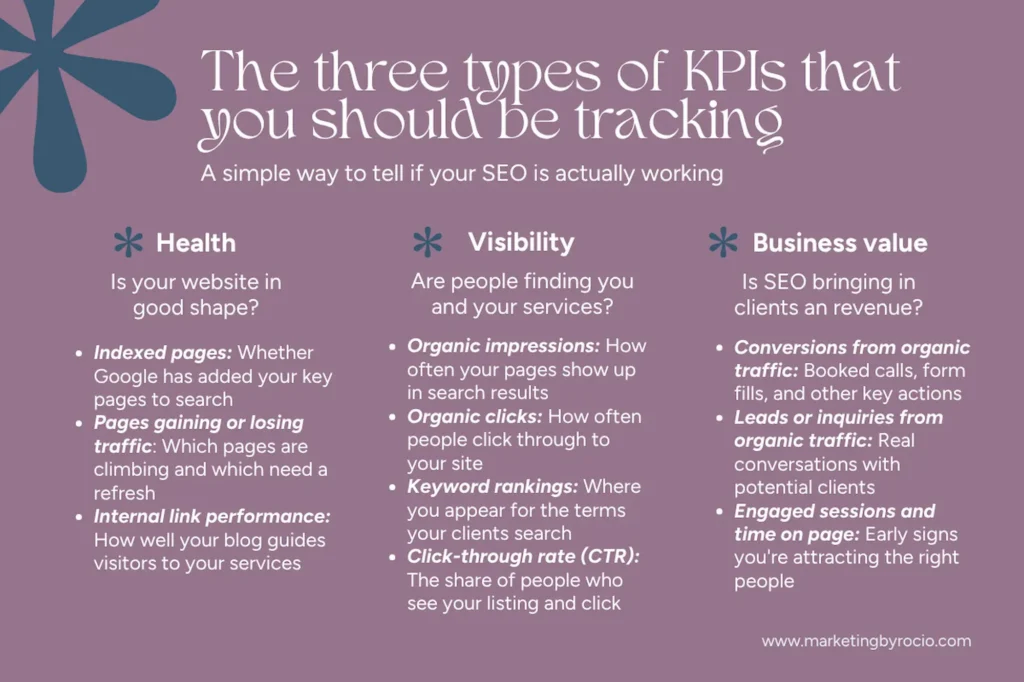
SEO KPIs fall into three buckets. Each one answers a different question about your website: is it healthy, are people finding it, and is it bringing in business? Together, they give you a clear picture of your business’s online presence without overwhelming you.
Health KPIs: is your website in good shape?
Think of these as the check engine light on your car. You don’t need to stare at them every day, but you do want to know when something’s off.
Health KPIs sit underneath everything else, because if Google can’t properly find and understand your site, your visibility and results will always be held back.
Indexed pages
These show how many of your pages Google has added to its search results.
Before a page can rank for anything, Google needs to find it, understand it, and decide it’s worth including. If an important service page isn’t indexed, nobody can find it in search. You can check this in the Pages report in Google Search Console.
The main thing to look for is whether your key pages, like your services, about page, and best content, are showing as indexed.
Having trouble getting your pages to show up? Here’s what to do when your pages aren’t getting indexed.
Pages gaining or losing traffic
These help you spot trends early. Rather than treating your website’s traffic as one big number, this KPI looks at how individual pages are doing over time.
A page that’s slowly sliding might have outdated information or new competition, so it could need a refresh. One that’s climbing is a sign you’ve hit on something your audience wants, which makes it worth building on with related content or a stronger call to action.
Internal link performance
Internal links work a bit like signposts around your site. Tracking how they perform shows whether your pages are guiding visitors (and Google) from your blog posts through to the pages that matter most.
When a helpful blog post links to a relevant service page, it gives readers a natural next step and tells Google which pages you consider important. If people rarely move from your blog content to your service or contact pages, your signposts might need some work.
If you’re not sure where your site stands, a small business SEO audit is a great place to start.
Want more insights like this?
I send out a monthly newsletter where I unpack everything from SEO-first strategy to real client lessons and the behind-the-scenes of building a values-led digital business. If you’re into honest takes on what makes websites actually work (not just look good), you’ll probably want in.
Visibility KPIs: are people finding you?
These are the numbers most people think of first. The good thing is that you can easily find most of them in your Google Search Console metrics. If you haven’t used it before, Google Search Console is a free tool from Google that shows how your website is performing in search, including how often your pages appear, how many people click through, and which search terms bring them to your site.
Organic impressions
Not all impressions are created equal. Organic impressions count how often your pages appear in search results, whether or not anyone clicks.
Rising impressions usually mean Google is showing your pages for more searches, which is a good early sign, especially for newer content. An impression still counts when your page is sitting on page three, though, so treat this one as a measure of reach.
Organic clicks
These count how often people click through to your site from search. This is where visibility starts turning into visits, and looking at which pages and search terms earn the most clicks tells you a lot about what your audience is really looking for.
Keyword rankings
Keywords still matter in today’s SEO. These rankings show where you appear for the search terms that matter to you. It’s tempting to track dozens of keywords, but a short list of terms your ideal clients would realistically search (like “anxiety therapist for teens” rather than just “therapy”) will tell you much more.

Click-through rate (CTR)
CTR is probably one of the most common KPIs you’ve heard of. It’s the percentage of people who saw your listing and clicked on it. A low CTR on a page that ranks well often means your page title and meta description aren’t clearly matching what people are searching for. It’s one of the easier things to improve in SEO, since a clearer, more inviting title can lift clicks without any change in rankings.
If you serve a local area, local SEO actions belong here too. Calls, direction requests, and website clicks from your Google Business Profile are some of the most valuable signals a local service business can track.
And with more people searching through AI tools like ChatGPT and Google’s AI Overviews, it’s worth checking whether your business shows up in AI answers, where you can track it. Searching for your main services in these tools every so often will give you a feel for whether you’re being mentioned.
To learn more about optimizing your content and website for AI, read our AI optimization guide.
Visibility KPIs are genuinely useful because they show that you’re being seen. But even when those numbers are climbing, they don’t mean much if people aren’t taking the next step. Whether anyone actually chooses you is a question for the next bucket.

Business value KPIs: is SEO bringing in work?
This is the bucket that matters most for service-based businesses, and funnily enough, it’s the one most SEO reports leave out.
Conversions from organic traffic
These show how many people who found you through search went on to book a call, fill out your contact form, or take another meaningful step. You can set these up as key events in GA4 so they’re tracked automatically. GA4 (short for Google Analytics 4) is Google’s free analytics tool, and it shows what people do once they land on your website, like which pages they visit and which actions they take. Start with the actions that matter most to your business (a booked consultation is worth more than a newsletter signup, for example).
Leads or inquiries from organic traffic
Leads or inquiries from your organic traffic show how many of those conversions turned into real conversations with potential clients. Some form submissions will be spam or a poor fit, so this KPI is about quality as much as quantity.
Adding a simple “How did you hear about us?” question to your contact form, or keeping a basic spreadsheet of where each new inquiry came from, can fill the gaps your analytics miss. This is where you start to see your actual SEO ROI.
Engaged sessions and time on page
These are good early signals. In GA4, an engaged session is a visit that lasted longer than 10 seconds, included more than one page view, or led to a key event. If people are sticking around to read, you’re probably attracting the right audience, even before they’re ready to reach out.
How to choose the right SEO KPIs for your business
There’s no universal “best” SEO KPI. The right ones depend on what success looks like for your business.
For example:
- A therapist might care most about contact form submissions, discovery call bookings, and local visibility.
- A consultant might focus on qualified inquiries, service page traffic, and visibility for their thought leadership content.
- A media company might track overall traffic, newsletter signups, and returning visitors, because for them, audience size really is the goal.
Your stage of growth matters too. On a newer website, health and visibility KPIs will tell you the most at first, since search traffic takes time to build. As things pick up, your focus can shift toward business value.
Instead of tracking everything in one go, pick three to five KPIs that line up with your goals and let the rest fade into the background. This keeps your approach focused without taking up too much of your time and energy.
If your site isn’t set up to turn visitors into inquiries, look into SEO-first web design and development, since even the best KPIs can’t fix a website that doesn’t convert.

Frequently asked questions about SEO KPIs
For most service-based businesses, it’s the number of leads or inquiries coming from organic search. That said, it depends on your goals, so a media site or online shop might put something else first.
A KPI in SEO is a key performance indicator. It’s a number you track because it shows whether your SEO is helping you reach a specific business goal, such as more inquiries or bookings.
They’re generally keyword research, on-page SEO, technical SEO, content, and off-page SEO (building authority through links and mentions). Each one feeds into the KPIs above.
A good monthly report includes a few KPIs from each bucket (health, visibility, and business value), a plain-English summary of what changed, and what’s planned next. If you finish reading it and still can’t tell whether your SEO is working, something’s missing.
Focus on the numbers that help you decide

At the end of the day, your SEO reports should make your decisions easier. A report packed with vanity metrics can look impressive, but the numbers that really deserve your attention are the ones showing your search visibility turning into real people getting in touch.
So instead of trying to track everything, pick a handful of KPIs that reflect what success looks like for your business, check in on them once a month, and give everything else a lot less of your headspace.
And if you’d love someone in your corner to help make sense of it all, that’s exactly what we do at Marketing by Rocio. We’ll help you work out which KPIs matter for your business, set up tracking that shows where your leads are really coming from, and turn your SEO reports into something you actually look forward to reading.
Ready to find out what your SEO is really doing for you? Get in touch with us and let’s chat about what success looks like for your business.