Last updated: October 19, 2026 | Reading time: 10 minutes
Is Divi good for SEO? Yes, it can be. Plenty of Divi websites rank well on Google, and the theme itself won’t stop yours from showing up in search.
But that’s only part of the story.
I’ve seen Divi websites rank. I’ve seen Divi websites fail. In both cases, the reason was rarely Divi itself.
Most people asking whether Divi good for SEO didn’t pick Divi from a list. They inherited a site, hired a developer who loves it, or built it themselves years ago. Now traffic is flat, and they’re wondering whether they need to start over.
After years of helping service-based businesses build their marketing plan, I’ve learned to ask a slightly different question: is Divi really what’s holding your site back? In my experience, it rarely is. Most websites have bigger SEO problems than Divi, and the good news is that those problems are usually easier (and cheaper) to fix than a brand-new site.
Why Divi has a mixed reputation for SEO
Spend five minutes on Reddit or in a WordPress forum, and you’ll find strong opinions about Divi SEO. The same complaints keep coming up:
- Divi can be heavier than lighter themes and builders.
- Older versions had a reputation for code bloat.
- Page speed can suffer when a site is built carelessly.
- A lot of developers simply don’t enjoy working with it.
To be fair, some of those complaints have a point. Older versions of Divi added a lot of extra code behind the scenes, and more code usually means slower pages. Pair that with cheap hosting, and you can end up with a site that feels sluggish.
Read those threads closely, though, and you’ll notice most people agree Divi sites can rank. What they’re really debating is efficiency: could the same site be a little lighter and faster on a different setup?
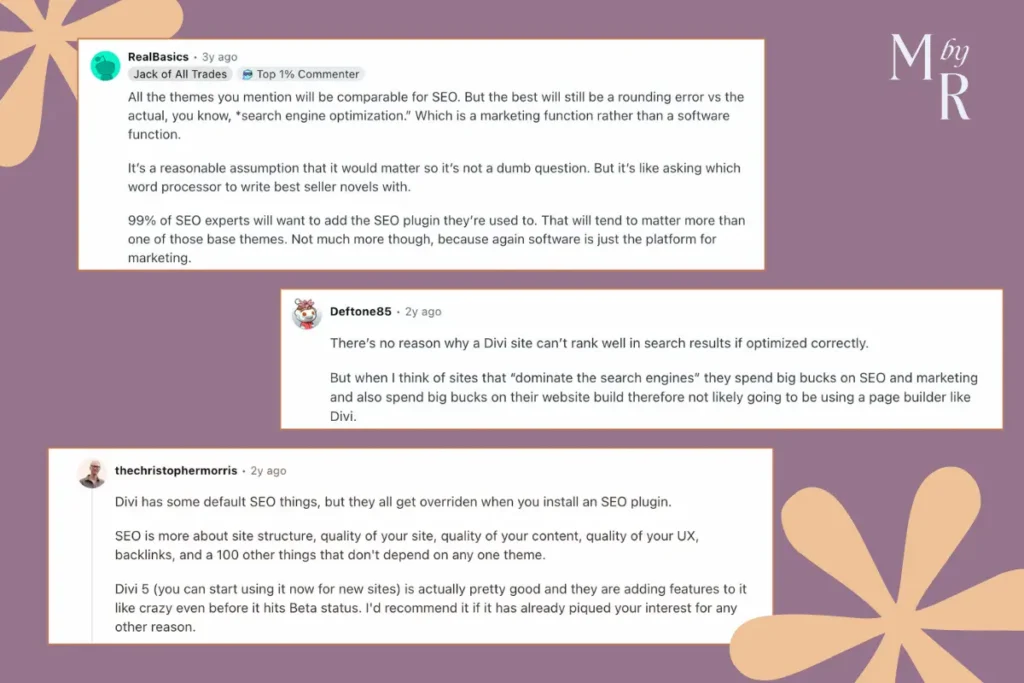
Sometimes, yes, your website can almost always be a bit “lighter”. But a leaner site doesn’t automatically rank higher. Speed is one of many things Google looks at, and once your pages load reasonably quickly, shaving off another fraction of a second usually won’t change much. Google puts far more weight on whether your page actually answers the searcher’s question. A slightly heavier page with genuinely helpful content will usually beat a lightning-fast page that says very little.
So does Divi hurt SEO? Not on its own. A well-built Divi site can hold its own in search, and much of the Divi page builder SEO debate comes down to developer preference, which rarely decides where you show up on Google.
The case for Divi
Let’s start with the big one: there’s no Divi penalty. Google judges your pages on whether they’re useful, relevant, and easy to use, and the page builder behind them isn’t part of that equation.
That’s why good SEO on the Divi theme looks a lot like good SEO anywhere else. Divi runs on WordPress, so you still get everything that makes WordPress a solid platform for SEO, including control over your titles, URLs, and site structure, plus plugins like Yoast or Rank Math.
Divi has been around since 2013, and it’s changed a lot in that time. The biggest shift came with Divi 5, which officially launched in February 2026.

Older versions of Divi saved every page as a long string of shortcodes. Think of shortcodes as little bracketed instructions, like [et_pb_section] or [et_pb_button], that WordPress has to read and translate into a real page each time it loads. Stack hundreds of them on one page, and all that translating adds up, which is where a lot of the bloat complaints came from.
Divi 5 moved away from that system, so pages carry much less extra baggage. That’s a big reason why the answer to “is Divi good for SEO?” looks better today than it did a few years ago, and why the link between Divi performance and SEO has changed so much.
One catch: if your site is still on Divi 4, or running Divi 5 in backward compatibility mode, you won’t see those gains yet. Updating may be a much smaller job than a rebuild.
Want more insights like this?
I send out a monthly newsletter where I unpack everything from SEO-first strategy to real client lessons and the behind-the-scenes of building a values-led digital business. If you’re into honest takes on what makes websites actually work (not just look good) you’ll probably want in.
The SEO problems people blame on Divi
When a Divi site struggles, the page builder usually gets blamed first. The real culprit tends to be one of these:
- Slow, cheap hosting: a bargain plan can make any site crawl, whatever theme it uses.
- Huge image files: one oversized homepage photo can slow things down more than your page builder ever will.
- Too many plugins: every plugin adds code, and twenty of them (half unused) add up fast.
- Weak content: if your pages don’t answer what people are searching for, speed won’t save them.
- Messy site structure: when pages are hard to find, Google struggles to figure out what your site is about.
Notice anything? None of these have anything to do with Divi. Switch page builders, or even jump ship to Wix, Squarespace, or Framer, and you’d carry every one of these problems right along with you.
So before you throw your laptop across the room and curse every Divi developer on the internet, check the usual suspects first: your hosting, your images, and your content. Most Divi website SEO problems turn out to be plain old website problems.

What matters more for your rankings than your page builder
These are the areas worth your time and budget. They matter on any platform, and they matter just as much for SEO on the Divi theme for WordPress.
Content that matches search intent
Search intent is the reason behind a search. Someone typing “Divi SEO tips” wants something very different from someone typing “web designer near me.” Pages that give people what they’re looking for tend to do well, however fast or slow they load.
Clear site structure and internal linking
Good structure helps visitors find what they need and helps Google understand which pages matter most. Linking related pages together is one of the simplest ways to strengthen it, and it’s a big part of SEO-first web design.
Technical basics and Core Web Vitals
Speed still matters. Google uses Core Web Vitals to measure how quickly your pages load, respond, and settle. Each one has a “good” threshold, like your main content showing up within about 2.5 seconds. If your Divi site hits those marks, speed probably isn’t what’s holding you back.
So yes, Divi performance and SEO are connected. The connection is just smaller than most forum threads make it sound.
Do you need to rebuild your Divi website?
If you came here asking “is Divi good for SEO?” because you’re thinking about a redesign, start with what you actually care about. Can your site rank? Can the right people find you? Will this platform hold you back as you grow?

When sticking with Divi makes sense
Keep your Divi site if it loads reasonably quickly, you can update it without calling a developer, and the gaps are mostly in content, structure, or technical SEO. Fixing those almost always costs less than starting over. Improving your Divi website SEO is often a cleanup job, and your WordPress Divi SEO setup can stay exactly where it is.
If you’re on the fence, it helps to know when a redesign actually makes sense for SEO.
When it’s worth considering something else
A rebuild might be the right call if your site is old and fragile, buried under plugins, or impossible for your team to maintain. It also makes sense if you’re redesigning for business reasons anyway, like a rebrand.
If you do rebuild, plan an SEO-friendly website redesign, because a careless one can wipe out years of rankings. And if you’d rather not manage WordPress at all, this guide to the best CMS for small business SEO can help you compare your options.
Frequently asked questions about Divi and SEO
Not on its own. Google doesn’t penalize sites for using Divi. Problems usually come from heavy images, too many plugins, cheap hosting, or an old version that never got updated. Fix those and a Divi site can compete with anything else.
This trips people up because Divi runs on WordPress. The real Divi vs WordPress SEO comparison is Divi versus a lighter WordPress theme. A lighter setup can be a little faster, but both can rank well when the content and structure are solid.
Yes. Most small business sites need clear service pages, helpful content, and a well-organized setup, and Divi handles all of that. Strong Divi theme SEO depends more on who builds and maintains the site than on the theme itself, so it’s worth knowing how to tell if your web developer understands SEO.
Elegant Themes describes Divi 5 as a big step forward for performance, largely because it moved away from shortcodes. They haven’t published official speed benchmarks, so results vary from site to site. If you’re still on Divi 4, updating is a sensible first step.
Probably not by itself. Divi page builder SEO and Elementor SEO come with similar trade-offs. If your content and structure are weak, they’ll be just as weak on Elementor. Switching only helps when the builder is the real bottleneck, which is rare.
The best WordPress theme for SEO is one you can keep fast, well organized, and easy to update. That could be Divi or a lightweight theme. The content and structure you build on top of it matter far more.
Is Divi good for SEO for your business?

For most business owners, yes. Divi can support a site that ranks well, and the biggest wins usually come from content, structure, and the technical basics every platform needs.
I get it. When traffic is flat, a fresh start feels like the obvious fix, and forum debates about page builders only make the decision harder. Before you spend money on a rebuild, get a clear picture of what’s really going on.
That’s what we do at Marketing by Rocio. We look at your site as a whole, find what’s actually limiting your visibility, and help you decide whether to fix, update, or rebuild.
If you’re not sure where your site stands, get in touch, and we’ll figure it out together.