Last updated: June 14, 2026 | Reading time: 10 minutes
Spending Sunday night writing captions, scheduling posts, drafting a blog, and wondering why none of it is translating to actual inquiries is a very specific kind of tired. Most business owners who feel burned out by marketing aren’t doing too little. Actually, it’s the opposite.
Combining SEO and social media doesn’t mean doing more of both. The idea is simpler than that: write one strong piece of content built for search, then break it into smaller pieces to share across social media. You create less, stay visible longer, and the same work does two jobs at once. More importantly, you’re saving yourself from a lot of unnecessary stress.
Why SEO is your foundation in SEO and social media strategy
SEO shows up when someone is actively searching for an answer. They open Google, type a question, and click whatever looks most useful. Social media shows up when someone is already scrolling. They might enjoy your post, save it, or even follow you. But they weren’t looking for you specifically.
An SEO and social media strategy that tries to run both channels at full intensity will wear you out. Social media needs fresh content constantly. Post on Monday and by Thursday it’s already buried under everything else in the feed.
SEO doesn’t work that way. A well-optimized blog post keeps showing up in search results for months, sometimes years, without you touching it again. Every new visitor it earns is essentially free. That compounding effect is the main reason to make SEO your foundation.
If you’re still weighing whether the investment makes sense, this breakdown on whether SEO is worth it in 2026 is honest about the timeline and what to expect.

How social media helps SEO (and where the confusion usually starts)
How social media helps SEO is a question that generates a lot of conflicting takes. Short answer: not directly. Google has confirmed that social signals like likes, shares, and follower counts are not ranking factors.
Well, does that mean they’re not useful? Nope! The indirect effects of having a strong social media presence are very much relevant.
When a social post sends someone to your website, that visit counts toward your traffic. Or when someone discovers you on Instagram and later types your name into Google, that branded search adds to your search presence over time. Every time a journalist sees your content being shared and links to your site, that backlink directly affects your rankings.
So, does social media improve SEO in some direct, automatic way? No. But it creates more opportunities for the things that do affect rankings, like website traffic, branded searches, and backlinks. The key thing here is that your social content needs to be pointing people back to your actual website, not just keeping them on the social platform.
This is where most SEO vs social media marketing debates go wrong. Treating them as competitors skips the more useful question, which is how they can support each other when they’re set up to work in the same direction.
If you want to check whether your website is actually ready to receive that traffic, a small business SEO audit will show you what needs to be sorted before you start sending people to it.

Why the either/or framing keeps people stuck
The SEO vs social media marketing debate has pushed a lot of business owners into a corner that doesn’t actually exist. SEO-focused marketers say social media is a distraction. Meanwhile, social-first coaches say SEO takes too long to matter. Neither sees the full picture.
SEO builds searchable, lasting content that attracts people who are actively looking for what you offer. Social builds familiarity with people who aren’t searching yet but might be soon. Both are useful. The problem is trying to run both at full intensity without a system that connects them, and having unrealistic expectations while you’re at it.
Want to picture what early-stage growth looks like? Check out our SEO timeline guide.
A sequenced approach solves that. SEO earns the foundation because its results compound over time. Social media sits on top as the amplifier because it’s better at spreading what already exists than creating something from scratch.
Want more insights like this?
I send out a monthly newsletter where I unpack everything from SEO-first strategy to real client lessons and the behind-the-scenes of building a values-led digital business. If you’re into honest takes on what makes websites actually work (not just look good) you’ll probably want in.
The content workflow that makes this practical
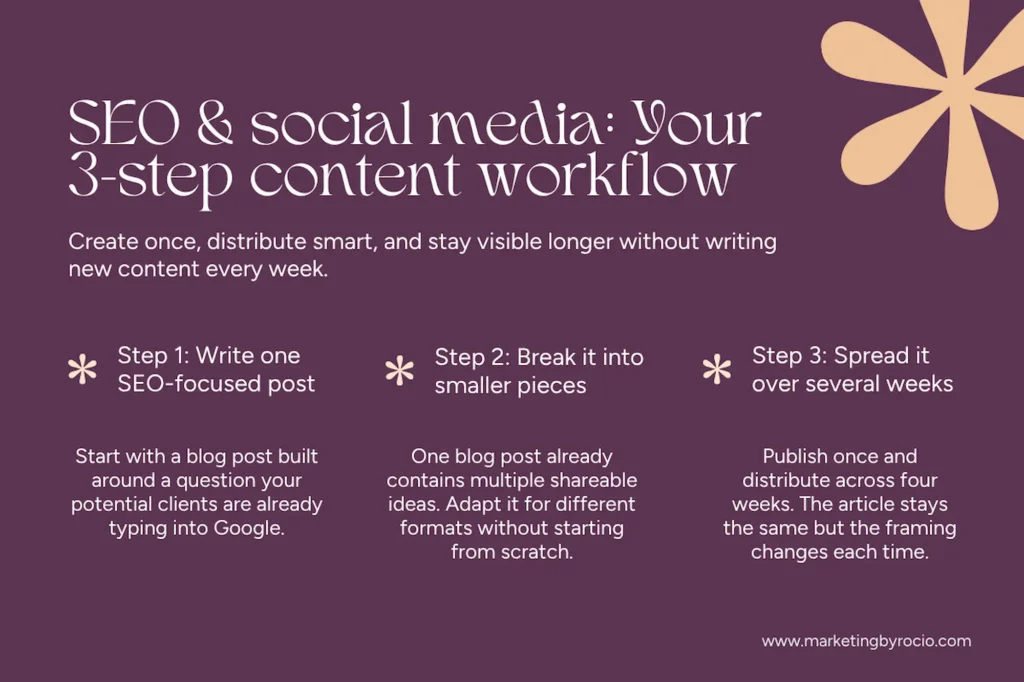
How to use SEO and social media together comes down to one repeatable three-step system.
Step 1: Write one SEO-focused piece of content
Start with a blog post built around a specific search query your potential clients are actually typing into Google. Not a topic you find personally interesting, but a question they’re already asking.
A financial planner could write “how to plan for retirement in your 30s.” or a massage therapist could write “what to expect from your first deep tissue massage.” If you’re a local service business owner, you could answer the question that comes up in almost every initial consultation.
The goal is to write something genuinely useful that earns search traffic and stays relevant long after it’s published.
Step 2: Break it into smaller pieces
This is where content repurposing for SEO and social media comes in. One blog post already contains multiple shareable ideas. You don’t need to whack your brain to find new things to say.
One post can become:
- Three to five LinkedIn posts, each built around a single insight from the article
- An Instagram carousel covering the main steps
- A short video addressing one specific section
- An email with the link and a short paragraph of context
- FAQ content that strengthens your site’s internal structure
With this strategy, you’re not creating 10 separate pieces of content but adapting one idea for different formats, with each version pointing back to the original post on your website. More content with less work.
Step 3: Spread it out over several weeks
Most people publish an article and share it once. That’s a bad move! Growing your business is a marathon and not a sprint. So, a smarter content distribution strategy spreads the same content across four weeks:
- Week 1: Publish the article. Share one social post linking to it.
- Week 2: Pull out one key insight and share it on LinkedIn.
- Week 3: Turn the main steps into an Instagram carousel.
- Week 4: Reshare the article with a fresh angle, or ask your audience a question based on the topic.
The article stays the same. The framing changes each time slightly. And your content keeps working without you having to write anything new. This is the core of social media for SEO done sustainably: one piece of content, multiple distribution points, everything pointing back to your website.

The omnipresence angle without being overwhelmed
A useful concept here is the omnipresence marketing strategy. The name sounds like a full-time job, but the idea is straightforward.
People find businesses through different channels on different days. Some come through Google. Others through a LinkedIn post they saved weeks ago, a YouTube video, or a referral that leads them to your site. The goal is to make one piece of content show up across more of those places over time. Remember that one strong asset, distributed well, beats a dozen forgettable ones published in a rush.
Frequently asked questions on how to combine SEO and social media
Consistency matters more than volume. One well-researched, genuinely useful post per month will outperform four rushed ones. Starting with one strong piece and repurposing it across social channels is a much more sustainable approach than trying to hit an arbitrary publishing quota.
Not directly, since social posts aren’t indexed by Google the way website pages are. But they’re a useful signal. If a caption consistently gets strong engagement, that’s evidence the topic has real interest behind it, and it might be worth expanding into a full blog post that can actually rank.
Start with what your clients already ask you in consultations, emails, and DMs. Those questions are direct evidence of what people are searching for. Google’s autocomplete and the “People also ask” section in search results are also surprisingly useful for understanding how people phrase their searches.
Repurposing means reworking the format and framing so it fits naturally in a new context. Taking a blog post and pulling out one insight for a LinkedIn post is repurposing. Copying and pasting the same caption across three platforms is just repetition, and audiences notice the difference.
It fits in as a distribution channel rather than a separate content system. A short email pointing people to your latest blog post takes a few minutes to write and consistently drives your warmest audience back to your site, which supports your organic traffic signals over time.
No, and spreading yourself across all of them at once is one of the faster routes to giving up entirely. Pick one or two platforms where your actual clients spend time. Depth on fewer platforms beats a thin, exhausted presence scattered across all of them.
Track organic traffic in Google Search Console and look for growth in impressions and clicks over three to six months. On social, watch for link clicks back to your site rather than just likes. Likes feel good. Traffic back to your website is the metric that connects both channels to actual business results.
Both approaches can work, but whoever writes them needs to understand your voice and your clients. Generic outsourced content that sounds nothing like you will underperform even when it’s technically optimized. If you bring in support, brief thoroughly and edit closely until the voice is right.
If this still feels like a lot to sort out, don’t hesitate to reach out

Setting this up does take some initial thinking, especially if your SEO and socials have been running as completely separate tasks with no overlap. But one connected system is far less draining to maintain than two disconnected ones running in parallel.
The goal is to get the most out of both your SEO and social media efforts without burning yourself out in the process. If you want help figuring out what that looks like for your business, we at Marketing by Rocio are here for that conversation.
We’ve worked with small business owners across different industries, helping them get more out of the channels they already have with strategies that actually fit their business.
Reach out and let’s figure out what that looks like for yours.