Last updated: May 30, 2026 | Reading time: 11 minutes
A local therapist spends $1,200 on paid ads and gets three inquiries. Then, a roofing company barely touches ads, but their Google Business Profile brings in calls every week. Meanwhile, a coach with a decent blog keeps booking discovery calls from people who found her through search six months after she published a single article.
These different results are exactly why SEO vs. paid ads for small businesses doesn’t have a clean universal answer. And the question most business owners are sitting with is more urgent: What will actually bring in clients without bleeding my budget dry?
Paid ads can get you visible fast, while SEO builds traffic that doesn’t disappear the moment you pause spending. For most service-based businesses, where people are already searching for what you offer, SEO is the stronger foundation. Paid ads layer in well once that foundation is solid.
But there’s more to this… Where you start depends on where your business actually is right now, and what your website is ready to do with traffic once it arrives.
What’s the actual difference?
The question of SEO vs paid ads comes down to how you want to earn visibility.
SEO earns your place in search results through content, relevance, and authority. Meanwhile, paid ads buy placement. Both work provides you with visibility. It’s just that one builds something that keeps working, and the other stops the second the budget does.
Organic traffic vs paid traffic also behaves differently. Organic visitors tend to come with more trust because they found you through an active search. They were already looking for a solution, typed something into Google, and chose to click on you. Paid traffic can convert well, too, but it’s more unsteady. Turn off the spend and it often disappears overnight.
Search intent is another factor you need to understand. It’s understanding the “why” behind people’s search queries in Google and other search engines. When someone types “trauma therapist in Denver” or “tax accountant for freelancers near me,” they’re actively looking for help now. That’s a different mindset than someone who sees an Instagram ad while watching cooking videos. For most service businesses, active search intent tends to convert at a higher rate.
Timing also plays a huge factor here. Google Ads can start sending traffic within hours. But SEO typically takes three to six months to build real traction, sometimes longer in competitive industries. That gap is worth considering before committing to either one.

Why SEO tends to be the foundation for service businesses
For most service providers, SEO for small businesses is the stronger long-term investment. And this is not entirely biased towards SEO, but about how service businesses actually get found.
If you’re a therapist, accountant, designer, consultant, plumber, or local service provider of any kind, people are already going to Google and typing things like “trauma therapist in Austin” or “bookkeeper near me.” So, it’s either they’ll find you or a competitor down the street.
It’s a very different situation from a brand-new product or service that nobody knows to search for yet. When demand already exists, SEO has a natural structural advantage.
And there’s SEO’s underappreciated compounding effect. For example, a therapist writes a helpful article about managing work-related anxiety. Six months later, it starts ranking for a few related searches. Then a year later, it’s still bringing in inquiries without any additional work on that page. That’s how the compounding effect works.
But none of those happen by accident, though. SEO isn’t just plugging keywords into an article and hoping Google figures out the rest. When done well (emphasis on this one!), the results stick around.
While that kind of return doesn’t happen overnight, it also doesn’t require an ongoing budget to sustain itself. And unlike social platforms, you’re not dependent on an algorithm deciding how many people see your content today.
If you want a realistic picture of what to expect, this SEO timeline guide breaks down what actually happens in the first 30 days following this strategy.
When paid ads actually make sense
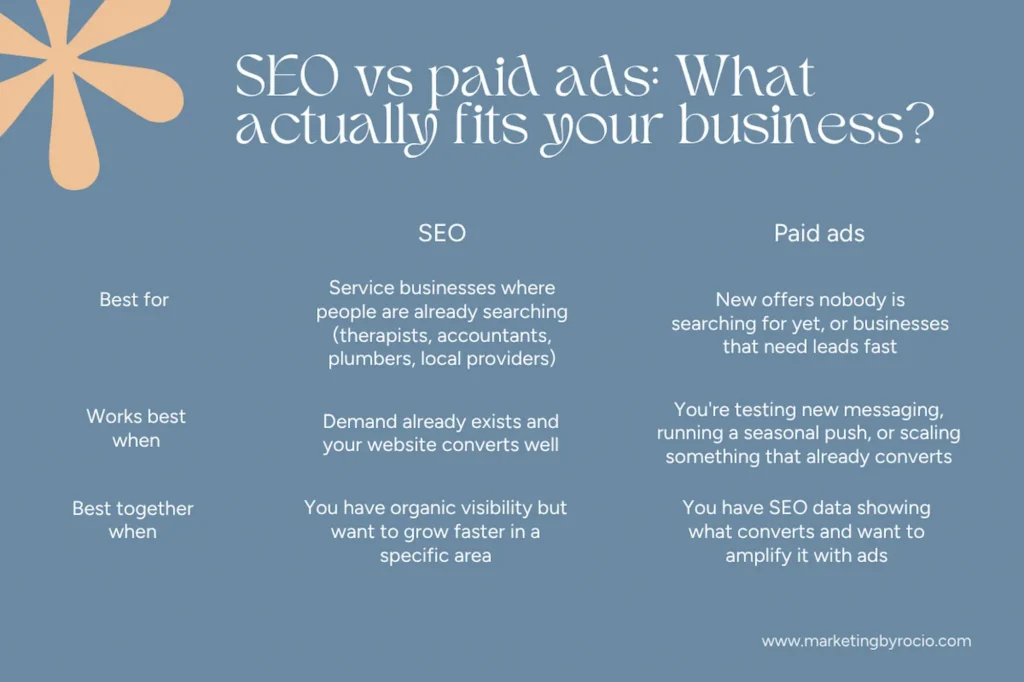
Paid ads for small businesses are the right call in specific situations. They make sense when:
- You need leads this month, not in six months
- You’re launching something new and want to test messaging quickly before investing heavily in content
- You have a seasonal push with a short window
- Your conversion rate is already solid, and you want more volume
A new coaching offer is a good example. If nobody is searching for your specific program yet, SEO can’t help much. Paid ads let you test what resonates before building out a whole content strategy around it.
But there’s something most people don’t factor in when they sit down to compare the cost of SEO vs paid ads: whether their website is actually ready to convert the traffic they’re paying for.
Ads amplify what already exists. If your website is slow, your offer is vague, your testimonials are buried, or your contact page is three clicks deep, ads just deliver frustration instead of clients. In most of these cases, the ads were fine, but the destination wasn’t ready.
Before putting more money into ads, you should know if your site is already losing people who do find it. A small business SEO audit can surface those gaps before you throw more traffic at them.

The cost reality for small business budgets
Most small business owners are not sitting on enterprise marketing budgets. That’s a reality that changes the SEO vs PPC conversation quite a bit.
If the budget is tight, SEO generally delivers better long-term value. It requires time and consistency, but it’s not a spend-to-compete model the way paid search can become.
In competitive industries, ad costs keep climbing regardless of your budget. According to WordStream’s 2025 Google Ads benchmarks, the average cost per lead has been rising steadily year over year, with some industries seeing increases of up to 25% in a single year. In fields like legal, finance, and home services, a single click on a Google ad can now cost close to $9. The same budget that brought in consistent leads a couple of years ago is simply stretching less far today.
There are also hidden costs people rarely factor in. A/B testing ads, paying for design assets, continually updating copy, managing campaigns, and dealing with rising cost-per-clicks (CPCs) in a competitive space all add up. SEO has its own costs, but the compounding nature means the return tends to improve over time rather than staying flat or declining.
SEO is slower, that’s for sure. But once it’s working, the leads it generates aren’t costing you per click. That math becomes more favorable the longer the business runs.
Want more insights like this?
I send out a monthly newsletter where I unpack everything from SEO-first strategy to real client lessons and the behind-the-scenes of building a values-led digital business. If you’re into honest takes on what makes websites actually work (not just look good) you’ll probably want in.
Using SEO and paid ads together
Doing SEO and paid ads together is where things get more sustainable for a growing business, and it’s less complicated than it sounds.
Most businesses that rely entirely on one channel eventually feel the risk. Ads get expensive or unpredictable, and organic traffic takes longer than expected. A phased approach tends to work better than going all-in on either.
In practice, a small service business might spend the first six months building the SEO foundation before touching ads at all. That means getting the service pages in shape, setting up local SEO, starting a content strategy, and making sure the website is actually converting visitors into inquiries.

Once that’s working, Google Ads can come in to accelerate growth in a specific service area or location. From there, both channels can expand together as the business stabilizes.
Both also benefit from each other. SEO data tells you which keywords and questions actually lead to conversions, which improves your ad targeting. Ad campaigns show you what messaging resonates quickly, which informs your content strategy. They’re complementary when used intentionally.
But intentionally is the keyword here. Together doesn’t mean full spending on both simultaneously from day one.
What your business is actually ready for
Before deciding between SEO and paid ads, you must know what your business is actually ready for. These four questions are worth answering before spending anywhere:
How urgently do you need leads?
If the pipeline is empty right now, ads can help faster. But if you have some breathing room, start SEO immediately. The longer you wait, the longer it takes to affect. Both timelines are real, and it’s worth being honest about which situation you’re actually in.
Are people already searching for what you offer?
If yes, SEO has a structural advantage. Someone already wants what you do. You just need to show up when they go looking. If not, ads can help create awareness and test messaging first.

Is your website actually ready?
A site with slow load times, unclear messaging, or a contact process that asks too much from the visitors will always underperform, regardless of which channel sends traffic to it. Fixing this first improves every marketing channel at once. If you’re not sure where yours stands, knowing if SEO is the right choice for your business is a good place to start before committing to either channel.
Can you commit long enough to see results?
SEO rewards consistency over months. Paid ads reward ongoing testing and optimization. Neither works as a one-week panic response, and treating them that way tends to produce the kind of frustrated “nothing works” conclusions that aren’t really about the channels at all.
Frequently asked questions about Google Ads vs SEO for small businesses
For long-term visibility and lower cost per lead over time, usually yes. But paid ads still make sense for launches, testing, or filling the pipeline quickly.
Most businesses see meaningful traction within three to six months. Local SEO can move faster, but for competitive industries it may take longer.
Yes, and it often works better that way. SEO builds long-term visibility while ads handle immediate traffic. Each also produces data that makes the other sharper.
SEO usually becomes more cost-effective over time because organic traffic continues without paying per click. PPC requires an ongoing budget to stay visible.
It can be, especially with a clear offer and a strong landing page. A weak website makes ads significantly less effective and more expensive.
Yes! Sending paid traffic to a site that doesn’t convert clearly will drain the budget fast without much to show for it.
Focus on SEO first. Building local search visibility, optimizing your service pages, and creating useful content costs mostly time rather than ad spend.
Google search captures active intent. Someone is already looking for a solution. Social ads interrupt attention. Google Ads don’t have as much trust as organic content. For service businesses, search intent typically converts better because the person is already looking for help.

You don’t have to figure it out under pressure
A lot of the stress around SEO vs paid ads for small businesses comes from feeling like you have to make the perfect call with a limited budget and no clear roadmap.
For many small businesses, the answer is to build the SEO foundation first, get the fundamentals right, and layer in ads when the website and offer are actually ready to convert.
If you’re not sure whether to start with SEO, run ads, or fix the website first, that’s exactly the kind of decision Marketing by Rocio helps with. We’ve worked with small service-based businesses to build the right SEO foundation, so that when paid ads do come into the picture, there’s actually something solid to send traffic to.
If organic search feels like the more sustainable path for your business right now, our service-based business SEO is a good place to start.
Reach out for an assessment, and we’ll help you figure out what your business needs first.